
Myszor. Data, Context, Logic plus Design

The Prompt Is Already the Answer

Why a prompt covers one of four stages of creative work, and why quality is decided before and after it

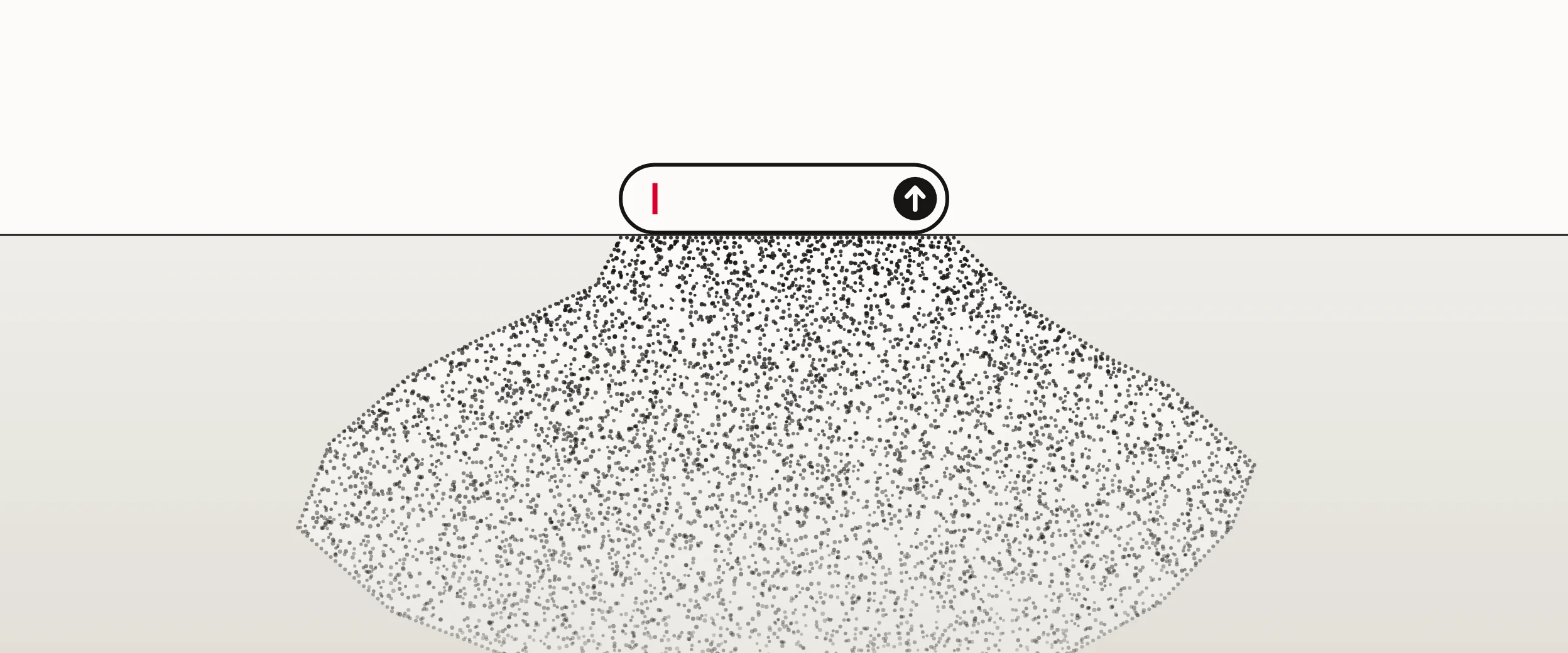
An AI prompt field with a red cursor is the tip of an iceberg. Below the waterline lies a far larger body of ice, drawn in dots.

If you can write the prompt, you already know what you want. That is the quiet condition every text box puts on you: say it in words. Most of the work that decides whether a product, a campaign or a decision will hold happens where there are no words yet, and again after the words have done their job.

That is the whole argument. The rest is where it leads.

1Four stages, one of them typed

Creative work moves through four stages. They sit on my logo because they describe the work more accurately than any list of disciplines.

1Data

Raw material, unsorted, without a question yet. Numbers, documents, interviews, the things an expert knows and has never written down. AI can collect it. It cannot weigh it, because weighing needs a question.

2Context

The search. Understanding what the problem is, and finding what nobody was looking for. This stage has no language yet. There is almost nothing to prompt, because nothing can be formulated.

3Logic

The rule, the structure, the decision with its reasons. This stage is made of language. It is where AI is strong, and where it gets faster every month.

4Design

The translation back into something people can feel, use and trust. Language leaves again. AI produces variants here. It does not produce a stance.

A prompt sits on stage three. It is Logic without Context before it and without Design after it.

Whoever only prompts works on one of four stages and takes it for the whole process.

One correction before this reads like a recipe. These are stages, not steps. Dorst and Cross watched experienced designers at work in 2001 and found that problem and solution develop together: a partial solution changes what the problem is, a new source topples a rule, a design decision sends you back to the context. The four stages name activities that overlap, with loops between them. Anyone who sells them as a sequence will be corrected by the first practitioner in the room.

2A question at the start, or an answer

Two movements run through every piece of creative work, and they get confused all the time.

The search is open-ended, pre-verbal, not steerable. It is valuable because you find what you were not looking for. Data and Context live here. At the start stands a question.

The delivery is directed, accountable, measurable against a result. Judgement sits here, and so does AI as an accelerator. Logic and Design live here. At the start stands an answer.

Both are creative. The difference lies in one thing only: whether the work begins with a question or with an answer.

The search is not a luxury. Getzels and Csikszentmihalyi gave art students a table of objects and watched them. Some chose quickly and started drawing. Others handled the objects, turned them, rearranged them, began again. The explorers produced the more original work, and years later their early behaviour still predicted who had made a career. Michael Polanyi put the underlying limit in one sentence in 1966: we can know more than we can tell. A prompt only takes what you can tell.

3What the usual use of AI does to the search

The evidence on AI and creative work is more precise than the debate around it.

Doshi and Hauser showed in 2024 that writers who received ideas from a language model wrote stories that readers rated as better, with the biggest gains for the less practised writers. The same stories resembled each other more than the stories written without help. Individually better, collectively narrower. Azad and Baten made that effect measurable in 2026 and found it for marketing slogans as well as for stories: the leading models produce ideas that crowd into the same space. In Harvard Business Review, researchers from Harvard and Wharton described the same pattern at the end of 2025: individuals come up with more original ideas when they work with language models, while the ideas across a group grow more alike.

The important detail is that this narrowing comes from how the tools are used, not from the models alone. Change the protocol, vary the inputs, vary the perspectives, and the crowding drops. The remedies the same researchers name are concrete: examples in the prompt, models trained on your own material, answers grounded in your own sources. So the honest sentence is this: AI in the usual application narrows the search, and whoever does not design that application gets the narrowing for free.

There is a second detail that should worry anyone who runs a creative team. When researchers offered design students sketches and tags as alternatives to the text box, the students still preferred typing. The narrowing channel is the comfortable one, nobody is forced to choose it, and almost everyone does.

A third detail shows who gains. Lu and colleagues reported in Harvard Business Review in January 2026 that AI raises creativity mainly for employees with strong metacognition: people who plan, monitor and refine their own thinking. They use AI to widen what they know and to break fixed patterns. The skill that decides sits before the prompt.
4What this means for decisions that have to hold

If the prompt is already the answer, then the access to what comes before it is the part that cannot be automated away. That access is a service. It costs visible effort, and it is bought by people who cannot or do not want to do it themselves.

An example from my own work. A world market leader in mechanical engineering wanted its operating data and its experts' knowledge turned into a digital product for the teams that run the machines. Before the first rule was written, there were 24 interview and field sources: shifts observed, service technicians asked, planning sheets read. Nobody could have prompted what came out of that. The rules were the easy part. Finding the question was the work.

And the after matters as much as the before. Logic delivers rules, and rules alone are a document. Design carries them back into something a planner opens at six in the morning and trusts enough to act on. If you stop at Logic, you have a document. The whole point was something people use.

The decision stays with a person. AI can carry the middle of the chain at a speed no team can match. The question at the start and the trust at the end are what someone has to answer for with their name.

5What To Do Now

  1. Tomorrow.

    Take the last prompt you wrote for anything that mattered. Write down what you had to know before you could write it. That list is the work you are not paying for yet.

  2. This week.

    Budget the search. Interviews, time in the field, data without a question attached. Give it a line of its own, so that it stops being swallowed by the delivery.

  3. This month.

    Design how your team uses AI. Different inputs, different perspectives, more than one way in. Keep a human checkpoint where the rules become a product. Then look at whether the variants on the table still differ from each other.

The prompt is already the answer. The work is finding the question, and carrying the answer into something people trust.

Sources

  1. Dorst, K. and Cross, N. (2001): Creativity in the design process: co-evolution of problem-solution. Design Studies 22(5).
  2. Getzels, J. W. and Csikszentmihalyi, M. (1976): The Creative Vision. A Longitudinal Study of Problem Finding in Art. Wiley.
  3. Polanyi, M. (1966): The Tacit Dimension.
  4. Doshi, A. R. and Hauser, O. P. (2024): Generative AI enhances individual creativity but reduces the collective diversity of novel content. Science Advances 10(28). https://www.science.org/doi/10.1126/sciadv.adn5290
  5. Azad, N. S. and Baten, R. A. (2026): Ex Ante Evaluation of AI-Induced Idea Diversity Collapse. https://arxiv.org/abs/2605.06540
  6. De Freitas, J., Nave, G. and Puntoni, S. (2025): Research: When Used Correctly, LLMs Can Unlock More Creative Ideas. Harvard Business Review. https://hbr.org/2025/12/research-when-used-correctly-llms-can-unlock-more-creative-ideas
  7. Lu, J. G., Sun, S., Li, Z. A., Foo, M.-D. and Zhou, J. (2026): Why AI Boosts Creativity for Some Employees but Not Others. Harvard Business Review. https://hbr.org/2026/01/why-ai-boosts-creativity-for-some-employees-but-not-others
  8. Wadinambiarachchi, Waycott and Wadley (2026): SketchifAI, arXiv 2606.26626.

Where does your company find the question?

Write to me if you want to talk about where the question gets found in your company.

A first call takes 30 minutes.

contact first call discovery proposal decision alignment scope workshop user test prototype kickoff

20+ years for Roche Pharma, BMW Group, Lufthansa, E.ON, KfW, Roland Berger, Telefónica.

GREGOR ADAM MYSZOR

Human. Data-driven. Connected.

Munich · Zurich · +49 171 5817497

Myszor. Data, Context, Logic plus Design
Contact

The Prompt Is Already the Answer

Why a prompt covers one of four stages of creative work, and why quality is decided before and after it

An AI prompt field with a red cursor is the tip of an iceberg. Below the waterline lies a far larger body of ice, drawn in dots.

If you can write the prompt, you already know what you want. That is the quiet condition every text box puts on you: say it in words. Most of the work that decides whether a product, a campaign or a decision will hold happens where there are no words yet, and again after the words have done their job.

That is the whole argument. The rest is where it leads.

1Four stages, one of them typed

Creative work moves through four stages. They sit on my logo because they describe the work more accurately than any list of disciplines.

1Data

Raw material, unsorted, without a question yet. Numbers, documents, interviews, the things an expert knows and has never written down. AI can collect it. It cannot weigh it, because weighing needs a question.

2Context

The search. Understanding what the problem is, and finding what nobody was looking for. This stage has no language yet. There is almost nothing to prompt, because nothing can be formulated.

3Logic

The rule, the structure, the decision with its reasons. This stage is made of language. It is where AI is strong, and where it gets faster every month.

4Design

The translation back into something people can feel, use and trust. Language leaves again. AI produces variants here. It does not produce a stance.

A prompt sits on stage three. It is Logic without Context before it and without Design after it.

Whoever only prompts works on one of four stages and takes it for the whole process.

One correction before this reads like a recipe. These are stages, not steps. Dorst and Cross watched experienced designers at work in 2001 and found that problem and solution develop together: a partial solution changes what the problem is, a new source topples a rule, a design decision sends you back to the context. The four stages name activities that overlap, with loops between them. Anyone who sells them as a sequence will be corrected by the first practitioner in the room.

2A question at the start, or an answer

Two movements run through every piece of creative work, and they get confused all the time.

The search is open-ended, pre-verbal, not steerable. It is valuable because you find what you were not looking for. Data and Context live here. At the start stands a question.

The delivery is directed, accountable, measurable against a result. Judgement sits here, and so does AI as an accelerator. Logic and Design live here. At the start stands an answer.

Both are creative. The difference lies in one thing only: whether the work begins with a question or with an answer.

The search is not a luxury. Getzels and Csikszentmihalyi gave art students a table of objects and watched them. Some chose quickly and started drawing. Others handled the objects, turned them, rearranged them, began again. The explorers produced the more original work, and years later their early behaviour still predicted who had made a career. Michael Polanyi put the underlying limit in one sentence in 1966: we can know more than we can tell. A prompt only takes what you can tell.

3What the usual use of AI does to the search

The evidence on AI and creative work is more precise than the debate around it.

Doshi and Hauser showed in 2024 that writers who received ideas from a language model wrote stories that readers rated as better, with the biggest gains for the less practised writers. The same stories resembled each other more than the stories written without help. Individually better, collectively narrower. Azad and Baten made that effect measurable in 2026 and found it for marketing slogans as well as for stories: the leading models produce ideas that crowd into the same space. In Harvard Business Review, researchers from Harvard and Wharton described the same pattern at the end of 2025: individuals come up with more original ideas when they work with language models, while the ideas across a group grow more alike.

The important detail is that this narrowing comes from how the tools are used, not from the models alone. Change the protocol, vary the inputs, vary the perspectives, and the crowding drops. The remedies the same researchers name are concrete: examples in the prompt, models trained on your own material, answers grounded in your own sources. So the honest sentence is this: AI in the usual application narrows the search, and whoever does not design that application gets the narrowing for free.

There is a second detail that should worry anyone who runs a creative team. When researchers offered design students sketches and tags as alternatives to the text box, the students still preferred typing. The narrowing channel is the comfortable one, nobody is forced to choose it, and almost everyone does.

A third detail shows who gains. Lu and colleagues reported in Harvard Business Review in January 2026 that AI raises creativity mainly for employees with strong metacognition: people who plan, monitor and refine their own thinking. They use AI to widen what they know and to break fixed patterns. The skill that decides sits before the prompt.

4What this means for decisions that have to hold

If the prompt is already the answer, then the access to what comes before it is the part that cannot be automated away. That access is a service. It costs visible effort, and it is bought by people who cannot or do not want to do it themselves.

An example from my own work. A world market leader in mechanical engineering wanted its operating data and its experts' knowledge turned into a digital product for the teams that run the machines. Before the first rule was written, there were 24 interview and field sources: shifts observed, service technicians asked, planning sheets read. Nobody could have prompted what came out of that. The rules were the easy part. Finding the question was the work.

And the after matters as much as the before. Logic delivers rules, and rules alone are a document. Design carries them back into something a planner opens at six in the morning and trusts enough to act on. If you stop at Logic, you have a document. The whole point was something people use.

The decision stays with a person. AI can carry the middle of the chain at a speed no team can match. The question at the start and the trust at the end are what someone has to answer for with their name.

5What To Do Now

  1. Tomorrow.

    Take the last prompt you wrote for anything that mattered. Write down what you had to know before you could write it. That list is the work you are not paying for yet.

  2. This week.

    Budget the search. Interviews, time in the field, data without a question attached. Give it a line of its own, so that it stops being swallowed by the delivery.

  3. This month.

    Design how your team uses AI. Different inputs, different perspectives, more than one way in. Keep a human checkpoint where the rules become a product. Then look at whether the variants on the table still differ from each other.

The prompt is already the answer. The work is finding the question, and carrying the answer into something people trust.

Sources

  1. Dorst, K. and Cross, N. (2001): Creativity in the design process: co-evolution of problem-solution. Design Studies 22(5).
  2. Getzels, J. W. and Csikszentmihalyi, M. (1976): The Creative Vision. A Longitudinal Study of Problem Finding in Art. Wiley.
  3. Polanyi, M. (1966): The Tacit Dimension.
  4. Doshi, A. R. and Hauser, O. P. (2024): Generative AI enhances individual creativity but reduces the collective diversity of novel content. Science Advances 10(28). https://www.science.org/doi/10.1126/sciadv.adn5290
  5. Azad, N. S. and Baten, R. A. (2026): Ex Ante Evaluation of AI-Induced Idea Diversity Collapse. https://arxiv.org/abs/2605.06540
  6. De Freitas, J., Nave, G. and Puntoni, S. (2025): Research: When Used Correctly, LLMs Can Unlock More Creative Ideas. Harvard Business Review. https://hbr.org/2025/12/research-when-used-correctly-llms-can-unlock-more-creative-ideas
  7. Lu, J. G., Sun, S., Li, Z. A., Foo, M.-D. and Zhou, J. (2026): Why AI Boosts Creativity for Some Employees but Not Others. Harvard Business Review. https://hbr.org/2026/01/why-ai-boosts-creativity-for-some-employees-but-not-others
  8. Wadinambiarachchi, Waycott and Wadley (2026): SketchifAI, arXiv 2606.26626.

Where does your company find the question?

Write to me if you want to talk about where the question gets found in your company.

Get in touch

A first call takes 30 minutes.

Share on LinkedIn
contact first call discovery proposal decision alignment scope workshop user test prototype kickoff

20+ years for Roche Pharma, BMW Group, Lufthansa, E.ON, KfW, Roland Berger, Telefónica.

GREGOR ADAM MYSZOR

Human. Data-driven. Connected.

Munich · Zurich · +49 171 5817497

Claude Partner Badge, Claude Code