
Myszor. Data, Context, Logic plus Design

The Skill That Stays

Why creativity remains the competitive edge with AI, and why its value moves from making to finding, choosing and judging

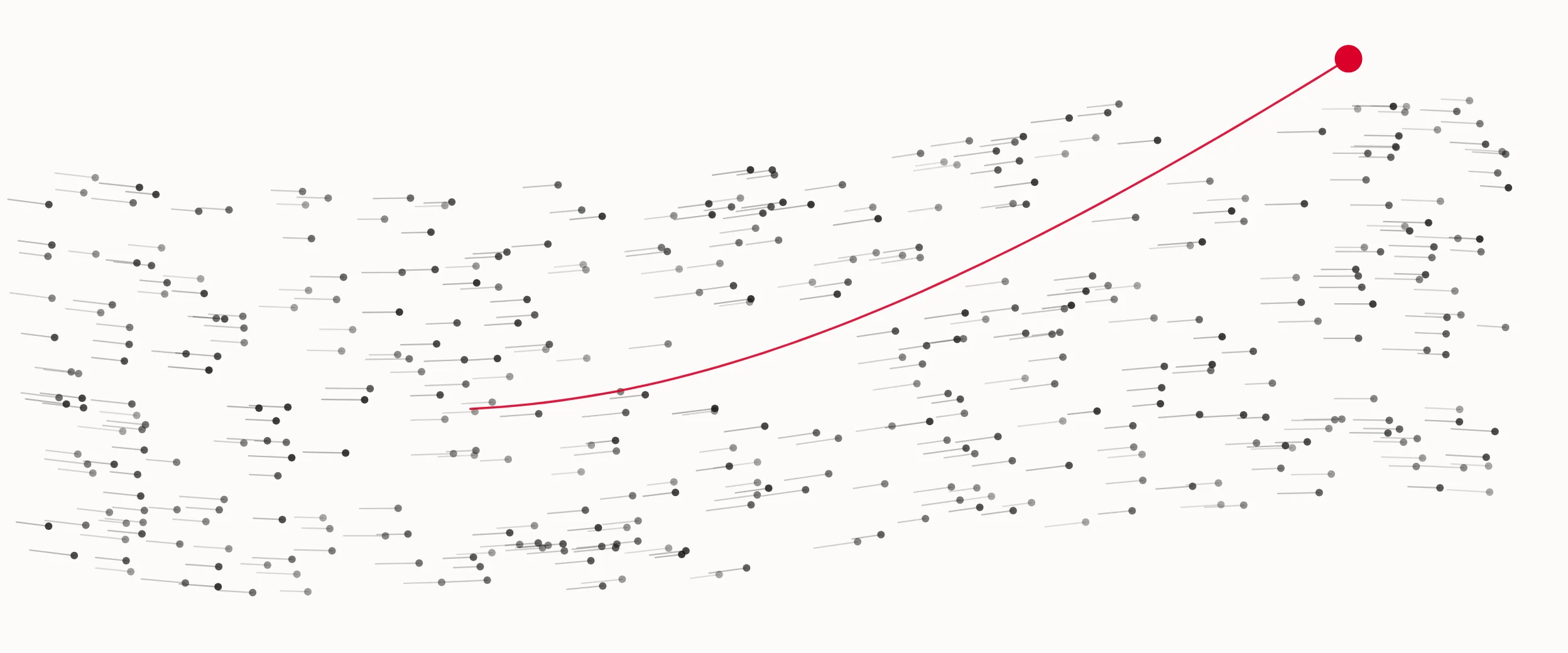
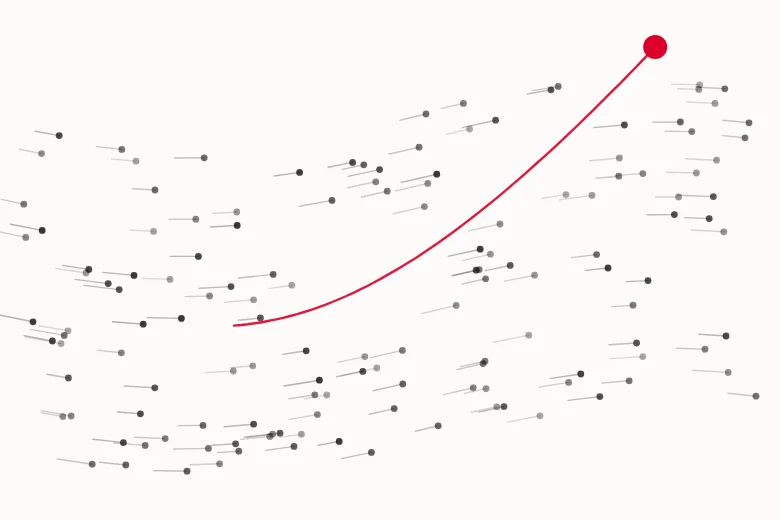
Abstract image: a swarm of small dark dots moves in one direction, all much alike. One red dot leaves the swarm and takes its own path, drawn as a thin red line.

Every few months a new model writes better copy, renders sharper images and produces more ideas than a team can read. The question follows quickly: what is left for people?

The data gives a clear answer. Creativity has ranked among the top five skills in every edition of the World Economic Forum's Future of Jobs Report since 2018. What changes is where its value sits. AI makes good average work cheap. The scarce part is everything that departs from the average: finding the problem, keeping the range of ideas wide, choosing, and standing behind a result.

1The skill keeps its place while the roles move

Every two to three years the World Economic Forum asks employers which skills matter most. Since 2018, creativity has ranked in the top five of every edition. In 2023, creative thinking led the list of skills on the rise. In 2025, it ranks fourth among the core skills, behind analytical thinking, resilience and leadership.

The distance to the top has shrunk. In 2018 and 2020, companies that counted analytical thinking among the core skills outnumbered those that counted creative thinking by 35 and 38 percent. In 2023, the gap was down to 21 percent. According to the Forum, creative thinking gains weight “as workplace tasks become increasingly automated.” CEOs said it even earlier: in 2010, IBM conducted 1,541 interviews with CEOs and senior leaders in 60 countries, and creativity came out as the most important leadership quality.

Top 5

in every Future of Jobs Report since 2018

World Economic Forum, 2018 to 2025

1,541

interviews with CEOs and senior leaders put creativity first among leadership qualities

IBM, 2010

5%

of recognition messages mention creative thinking, the human skill workers value most

World Economic Forum, 2025

30%

of leaders see time freed up by AI going into critical thinking and creativity

McKinsey, 2026

The 2025 edition adds a second finding. For the first time, graphic designers appear just outside the ten fastest-declining job roles. The skill rises while one of the classic roles that produce creative work declines. That is the shift in one sentence: creative production loses market value, and creative direction gains it.

2AI raises the average and narrows the range

My second essay described what the usual use of AI does to creative work, with the study by Doshi and Hauser: each story gets better, and together the stories become more alike. The evidence has grown since. In a 2026 study, Christian Terwiesch and colleagues found product ideas from language models seven times more likely to rank in the top ten percent, less novel as single ideas and less diverse as a set. Two meta-analyses, one across 28 studies and one across 19, confirm the narrowing. They disagree on its size, from small to large, and agree on its direction.

The loss shows in the pool. Each single output looks fine, so whoever approves work piece by piece never sees it. Lisa Smith, global chief design officer at Uncommon, describes the brand identities of AI companies as “branding by autocomplete”. Distinctiveness has become a property of the whole portfolio, and that is where it has to be measured.

3The value moves to finding and judging

My second essay described creative work in four stages: Data, Context, Logic and Design. Data is the raw material. Context is the search, where you work out what the problem actually is. Logic is the rule and the reasoned decision, put into words. Design translates it back into something people can feel. The stages loop, and the work often goes back.

AI is strongest where the work already exists in words. That is Logic. It is weakest where the words are still missing: in Context, where the problem has to be found, and in Design, where someone has to take a stance. Creativity research placed the core of the work in finding the problem long before language models, from the art students Getzels and Csikszentmihalyi observed to the designers Dorst and Cross studied in 2001.

The AI studies point the same way. In the Harvard and BCG experiment with 758 consultants, AI users were 19 percentage points less likely to get a business problem right when it lay outside what the model handles well. Figma's 2026 AI report puts it in one line: “AI can build almost anything. What it can't do is determine what's worth building”.

Practitioners say the same. In the AI in Design Report 2026, about 80 percent of more than 900 designers say AI assists but does not replace their own quality meter and creative direction. Karri Saarinen, co-founder and CEO of Linear, says it in one sentence there: “The hard part of design is rarely generating the form.”

A study from September 2026 shows what this looks like in daily work. Retkowsky, Hafermalz and Huysman followed advertising creatives working with Midjourney for a year. Their finding: “GenAI use in creative work leads to process collapse.” Generating, developing and producing ideas shrink into a single exchange with the model. Finished-looking images trigger what the authors call “early aesthetic closure”: GenAI outputs anchor the client's expectations and limit how far the idea develops.

Design leaders describe the same pull. Katie Dill, head of design at Stripe, on fast AI output: “It's like a burrito that took a minute and a half to microwave.” Nick Inzucchi, product designer at Cursor, on prototyping in code: “Code forces you to commit to your first idea and go deep”, at the expense of broad exploration.

The order matters as much as the tool. Across four studies, Boussioux, Doshi, Hauser and Hosanagar found that AI used to select ideas kept the range wide, while AI used to generate them narrowed it. Their conclusion: “The stage at which AI enters the workflow may matter as much as whether it is used at all.”

Once the direction stands, it has to be written down. Left to itself, a model returns what is typical of everything it has read. What pulls it toward one company's standard is that company's own rules: what good looks like, what is off-limits, who decides. Andrej Karpathy calls the text a model reads its lever.

4Metacognition decides who gains

My second essay mentioned that AI raises creativity mainly for people with strong metacognition. The study behind it deserves a closer look, because it was randomized and ran inside a real company. Sun, Li, Foo, Zhou and Lu randomly assigned 250 employees of a technology consultancy to work with or without ChatGPT (Journal of Applied Psychology, 2025). Supervisors rated the ChatGPT group markedly more creative. The gain depended on metacognition, the habit of planning, monitoring and correcting one's own thinking. For employees with weak metacognitive strategies, the effect was not significant. Jackson Lu sums it up: “Generative AI isn't a plug-and-play solution for creativity.”

The type of task decides the rest. Where the brief is already written, AI lifts the weaker performers most: in the BCG experiment, consultants below average improved by 43 percent, those above average by 17 percent. Where the task is open and calls for judgment, the stronger pull ahead: in a field experiment with Kenyan entrepreneurs, a GPT-4 assistant had no average effect, improved high performers by over 15 percent and set low performers back by around 8 percent.

In the four stages, that means: AI raises the floor in Logic and widens the gap in Context and Design.

A survey by Microsoft Research and Carnegie Mellon among 319 knowledge workers points the same way. The more people trusted the AI, the less critical thinking they reported. The more they trusted themselves, the more they reported.
5The strongest objection has data

The other side deserves a fair hearing. Its claim: ideas have become cheap, and AI produces better ones on average. In a 2023 Wharton study, 35 of the 40 best product ideas came from ChatGPT. In divergent-thinking tests, GPT-4 came out more original than a comparison group of 151 people. On freelance platforms, job posts for automatable writing and coding fell by 21 percent within eight months of ChatGPT's launch, and posts for image creation by 17 percent after image generators arrived.

Whoever claims AI cannot be creative loses against these numbers. The answer sits in the data too. In the Wharton study, the human ideas were more novel on average. Terwiesch's 2026 study found the better AI ideas less novel and less diverse. The objection hits creative production. Creative direction stands: finding the problem, keeping the range wide, choosing, and answering for the result.

How long that lead lasts is an open bet. The AI in Design Report 2026 names it: “AI may close the gap on craft and usability faster than on taste, judgment, and cultural foresight.”

6Most organizations are not built for it

The most surprising finding sits in organizations. Companies call creativity a top skill and barely measure, reward or make room for it. In recognition data from 73 countries, analyzed for the World Economic Forum, creative thinking carries the highest value of all human skills and appears in just 5 percent of the messages. In McKinsey's survey of more than 10,000 executives, only 30 percent of leaders see employees using time freed up by AI for critical thinking and creativity. Accenture Song found that 81 percent of leaders say their organizations can generate creative ideas, and only 16 percent very frequently turn them into growth. In design, the AI in Design Report counts just 28 percent of leaders who have implemented formal changes in their organizations.

McKinsey's Design Index shows what is at stake. Over five years, companies in its top quartile grew revenue 32 percentage points and shareholder returns 56 percentage points faster than their industry peers. McKinsey reports it as a correlation.

To pay off, creativity needs an architecture:

1Direction first

People set the problem and the context before the first prompt.

2AI later

Once the direction stands, AI varies, adapts and helps to select.

3Range as a metric

Review the portfolio as a whole and check how far the outputs differ.

4Judgment made visible

Reviews and promotions record who set the direction, and on what basis.

5Metacognition as training

Every AI rollout comes with practice in planning, checking and correcting one's own thinking.

6Rules in language, checks in code

Judgment and rules are written in plain language. Everything that can be stated exactly, such as numbers, deadlines and approval limits, runs deterministically in code.

The architecture needs an owner. Models and tools change every few months. The rules, the data and the contracts change slowly and carry what the company knows, so this slow layer has to belong to the company. The World Economic Forum's computing framework from October 2026 asks the same question of governments and organizations. It separates ownership from effective choice: can they switch providers, can they exit?

7How I work with it

In my own work the split is simple. AI carries much of what already exists in words: drafts, variants, research, quality checks. Context and Design stay with people: the expert interviews, the map of who decides what, the stance a product takes. What they decide goes into a rulebook the client owns, so every model after this one works to the same standard. That is where the value of my work sits. How such a rulebook starts to run is the subject of my next essay.

8What To Do Now

  1. Tomorrow.

    Take your last five creative projects and mark when the first AI output appeared. If it came before the problem was written down, the search ended too early.

  2. This week.

    Put ten recent outputs from different teams side by side. If they could come from one hand, your range has narrowed, however good each piece looks.

  3. This month.

    Add one question to every review: who set the direction, and on what basis? Pair your next AI rollout with training in how people plan, check and correct their own thinking.

The skill stays. Its value moves from making to finding, choosing and judging, and the organizations that build for that will own the difference.

Sources

  1. World Economic Forum (2018, 2020, 2023, 2025): The Future of Jobs Report. https://www3.weforum.org/docs/WEF_Future_of_Jobs_2018.pdf, https://www3.weforum.org/docs/WEF_Future_of_Jobs_2020.pdf, https://www3.weforum.org/docs/WEF_Future_of_Jobs_2023.pdf, https://reports.weforum.org/docs/WEF_Future_of_Jobs_Report_2025.pdf
  2. World Economic Forum (2025): New Economy Skills: Unlocking the Human Advantage. https://reports.weforum.org/docs/WEF_New_Economy_Skills_Unlocking_the_Human_Advantage_2025.pdf
  3. IBM Institute for Business Value (2010): Capitalizing on Complexity. Global CEO Study, 1,541 interviews. https://www.ibm.com/downloads/documents/us-en/10a99803fd2fddad
  4. Doshi, A. R. and Hauser, O. P. (2024): Generative AI enhances individual creativity but reduces the collective diversity of novel content. Science Advances 10(28). https://doi.org/10.1126/sciadv.adn5290
  5. Terwiesch, C., Meincke, L., Girotra, K., Mollick, E., Nave, G. and Ulrich, K. (2026). Production and Operations Management. https://doi.org/10.1177/10591478261474243
  6. Holzner, N., Maier, S. and Feuerriegel, S. (2025). Meta-analysis, preprint. https://arxiv.org/abs/2505.17241
  7. de Rooij, A. and Biskjaer, M. M. (2026): Generative AI makes creative output more homogeneous. ECCE 2026. https://research.tilburguniversity.edu/en/publications/generative-ai-makes-creative-output-more-homogeneous/
  8. Fast Company (2026): The biggest brand trends coming in 2026. https://www.fastcompany.com/91462141/the-biggest-brand-trends-coming-in-2026
  9. Getzels, J. W. and Csikszentmihalyi, M. (1976): The Creative Vision. A Longitudinal Study of Problem Finding in Art. Wiley.
  10. Dorst, K. and Cross, N. (2001): Creativity in the design process: co-evolution of problem-solution. Design Studies 22(5). https://oro.open.ac.uk/3278
  11. Dell'Acqua, F. et al. (2026). Organization Science 37(2). https://doi.org/10.1287/orsc.2025.21838. Working paper version: Harvard Business School Working Paper 24-013. https://mitsloan.mit.edu/sites/default/files/2023-10/SSRN-id4573321.pdf
  12. Figma (2026): 2026 AI Report. https://www.figma.com/blog/2026-ai-report/
  13. Retkowsky, J., Hafermalz, E. and Huysman, M. (2026). Academy of Management Discoveries. https://doi.org/10.5465/amd.2024.0280
  14. Boussioux, L., Doshi, A. R., Hauser, O. P. and Hosanagar, K. (2026): The Hidden Cost of AI-Assisted Creativity. MIT Sloan Management Review. https://shop.sloanreview.mit.edu/the-hidden-cost-of-ai-assisted-creativity
  15. Sun, S., Li, Z. A., Foo, M.-D., Zhou, J. and Lu, J. G. (2025): How and for whom using generative AI affects creativity: A field experiment. Journal of Applied Psychology 110(12), 1561-1573. https://doi.org/10.1037/apl0001296
  16. MIT Sloan School of Management (2025): Does generative AI actually enhance creativity in the workplace? Press release. https://mitsloan.mit.edu/press/does-generative-ai-actually-enhance-creativity-workplace
  17. Otis, N. et al. (2024): The Uneven Impact of Generative AI on Entrepreneurial Performance. Harvard Business School Working Paper 24-042. https://www.hks.harvard.edu/centers/cid/publications/uneven-impact-generative-ai-entrepreneurial-performance
  18. Lee, H.-P. et al. (2025): The Impact of Generative AI on Critical Thinking. CHI 2025. https://advait.org/files/lee_2025_ai_critical_thinking_survey.pdf
  19. Girotra, K., Meincke, L., Terwiesch, C. and Ulrich, K. (2023). Wharton Working Paper. https://mackinstitute.wharton.upenn.edu/wp-content/uploads/2023/08/LLM-Ideas-Working-Paper.pdf
  20. Hubert, K. F., Awa, K. N. and Zabelina, D. L. (2024). Scientific Reports. https://www.nature.com/articles/s41598-024-53303-w
  21. Demirci, O., Hannane, J. and Zhu, X. (2025). Management Science. https://spiral.imperial.ac.uk/entities/publication/88113a91-b994-4717-8526-dadac657f1cb
  22. Designer Fund and Foundation Capital (2026): AI in Design Report. https://stateofaidesign.com/
  23. McKinsey (2026): The State of Organizations 2026. Survey of 10,018 executives in 15 countries. https://www.mckinsey.com/~/media/mckinsey/business%20functions/people%20and%20organizational%20performance/our%20insights/the%20state%20of%20organizations/2026/the-state-of-organizations-2026.pdf
  24. Accenture Song (2026): Applied Creativity. https://www.accenture.com/us-en/insights/song/applied-creativity
  25. Sheppard, B., Sarrazin, H., Kouyoumjian, G. and Dore, F. (2018): The business value of design. McKinsey. https://www.mckinsey.com/capabilities/mckinsey-design/our-insights/the-business-value-of-design
  26. Karpathy, A. in conversation with Zhan, S. (2026): From Vibe Coding to Agentic Engineering. Sequoia Capital, AI Ascent 2026. Video interview.
  27. World Economic Forum (2026): The Next-Generation Computing Framework. White paper, 9 October 2026. https://www.weforum.org/publications/the-next-generation-computing-framework/

Who sets the direction before the first prompt?

Write to me if you want to work out who sets the direction in your company.

A first call takes 30 minutes.

contact first call discovery proposal decision alignment scope workshop user test prototype kickoff

20+ years for Roche Pharma, BMW Group, Lufthansa, E.ON, KfW, Roland Berger, Telefónica.

GREGOR ADAM MYSZOR

Human. Data-driven. Connected.

Munich · Zurich · +49 171 5817497

Myszor. Data, Context, Logic plus Design
Contact

The Skill That Stays

Why creativity remains the competitive edge with AI, and why its value moves from making to finding, choosing and judging

Abstract image: a swarm of small dark dots moves in one direction, all much alike. One red dot leaves the swarm and takes its own path, drawn as a thin red line.

Every few months a new model writes better copy, renders sharper images and produces more ideas than a team can read. The question follows quickly: what is left for people?

The data gives a clear answer. Creativity has ranked among the top five skills in every edition of the World Economic Forum's Future of Jobs Report since 2018. What changes is where its value sits. AI makes good average work cheap. The scarce part is everything that departs from the average: finding the problem, keeping the range of ideas wide, choosing, and standing behind a result.

1The skill keeps its place while the roles move

Every two to three years the World Economic Forum asks employers which skills matter most. Since 2018, creativity has ranked in the top five of every edition. In 2023, creative thinking led the list of skills on the rise. In 2025, it ranks fourth among the core skills, behind analytical thinking, resilience and leadership.

The distance to the top has shrunk. In 2018 and 2020, companies that counted analytical thinking among the core skills outnumbered those that counted creative thinking by 35 and 38 percent. In 2023, the gap was down to 21 percent. According to the Forum, creative thinking gains weight “as workplace tasks become increasingly automated.” CEOs said it even earlier: in 2010, IBM conducted 1,541 interviews with CEOs and senior leaders in 60 countries, and creativity came out as the most important leadership quality.

Top 5

in every Future of Jobs Report since 2018

World Economic Forum, 2018 to 2025

1,541

interviews with CEOs and senior leaders put creativity first among leadership qualities

IBM, 2010

5%

of recognition messages mention creative thinking, the human skill workers value most

World Economic Forum, 2025

30%

of leaders see time freed up by AI going into critical thinking and creativity

McKinsey, 2026

The 2025 edition adds a second finding. For the first time, graphic designers appear just outside the ten fastest-declining job roles. The skill rises while one of the classic roles that produce creative work declines. That is the shift in one sentence: creative production loses market value, and creative direction gains it.

2AI raises the average and narrows the range

My second essay described what the usual use of AI does to creative work, with the study by Doshi and Hauser: each story gets better, and together the stories become more alike. The evidence has grown since. In a 2026 study, Christian Terwiesch and colleagues found product ideas from language models seven times more likely to rank in the top ten percent, less novel as single ideas and less diverse as a set. Two meta-analyses, one across 28 studies and one across 19, confirm the narrowing. They disagree on its size, from small to large, and agree on its direction.

The loss shows in the pool. Each single output looks fine, so whoever approves work piece by piece never sees it. Lisa Smith, global chief design officer at Uncommon, describes the brand identities of AI companies as “branding by autocomplete”. Distinctiveness has become a property of the whole portfolio, and that is where it has to be measured.

3The value moves to finding and judging

My second essay described creative work in four stages: Data, Context, Logic and Design. Data is the raw material. Context is the search, where you work out what the problem actually is. Logic is the rule and the reasoned decision, put into words. Design translates it back into something people can feel. The stages loop, and the work often goes back.

AI is strongest where the work already exists in words. That is Logic. It is weakest where the words are still missing: in Context, where the problem has to be found, and in Design, where someone has to take a stance. Creativity research placed the core of the work in finding the problem long before language models, from the art students Getzels and Csikszentmihalyi observed to the designers Dorst and Cross studied in 2001.

The AI studies point the same way. In the Harvard and BCG experiment with 758 consultants, AI users were 19 percentage points less likely to get a business problem right when it lay outside what the model handles well. Figma's 2026 AI report puts it in one line: “AI can build almost anything. What it can't do is determine what's worth building”.

Practitioners say the same. In the AI in Design Report 2026, about 80 percent of more than 900 designers say AI assists but does not replace their own quality meter and creative direction. Karri Saarinen, co-founder and CEO of Linear, says it in one sentence there: “The hard part of design is rarely generating the form.”

A study from September 2026 shows what this looks like in daily work. Retkowsky, Hafermalz and Huysman followed advertising creatives working with Midjourney for a year. Their finding: “GenAI use in creative work leads to process collapse.” Generating, developing and producing ideas shrink into a single exchange with the model. Finished-looking images trigger what the authors call “early aesthetic closure”: GenAI outputs anchor the client's expectations and limit how far the idea develops.

Design leaders describe the same pull. Katie Dill, head of design at Stripe, on fast AI output: “It's like a burrito that took a minute and a half to microwave.” Nick Inzucchi, product designer at Cursor, on prototyping in code: “Code forces you to commit to your first idea and go deep”, at the expense of broad exploration.

The order matters as much as the tool. Across four studies, Boussioux, Doshi, Hauser and Hosanagar found that AI used to select ideas kept the range wide, while AI used to generate them narrowed it. Their conclusion: “The stage at which AI enters the workflow may matter as much as whether it is used at all.”

Once the direction stands, it has to be written down. Left to itself, a model returns what is typical of everything it has read. What pulls it toward one company's standard is that company's own rules: what good looks like, what is off-limits, who decides. Andrej Karpathy calls the text a model reads its lever.

4Metacognition decides who gains

My second essay mentioned that AI raises creativity mainly for people with strong metacognition. The study behind it deserves a closer look, because it was randomized and ran inside a real company. Sun, Li, Foo, Zhou and Lu randomly assigned 250 employees of a technology consultancy to work with or without ChatGPT (Journal of Applied Psychology, 2025). Supervisors rated the ChatGPT group markedly more creative. The gain depended on metacognition, the habit of planning, monitoring and correcting one's own thinking. For employees with weak metacognitive strategies, the effect was not significant. Jackson Lu sums it up: “Generative AI isn't a plug-and-play solution for creativity.”

The type of task decides the rest. Where the brief is already written, AI lifts the weaker performers most: in the BCG experiment, consultants below average improved by 43 percent, those above average by 17 percent. Where the task is open and calls for judgment, the stronger pull ahead: in a field experiment with Kenyan entrepreneurs, a GPT-4 assistant had no average effect, improved high performers by over 15 percent and set low performers back by around 8 percent.

In the four stages, that means: AI raises the floor in Logic and widens the gap in Context and Design.

A survey by Microsoft Research and Carnegie Mellon among 319 knowledge workers points the same way. The more people trusted the AI, the less critical thinking they reported. The more they trusted themselves, the more they reported.

5The strongest objection has data

The other side deserves a fair hearing. Its claim: ideas have become cheap, and AI produces better ones on average. In a 2023 Wharton study, 35 of the 40 best product ideas came from ChatGPT. In divergent-thinking tests, GPT-4 came out more original than a comparison group of 151 people. On freelance platforms, job posts for automatable writing and coding fell by 21 percent within eight months of ChatGPT's launch, and posts for image creation by 17 percent after image generators arrived.

Whoever claims AI cannot be creative loses against these numbers. The answer sits in the data too. In the Wharton study, the human ideas were more novel on average. Terwiesch's 2026 study found the better AI ideas less novel and less diverse. The objection hits creative production. Creative direction stands: finding the problem, keeping the range wide, choosing, and answering for the result.

How long that lead lasts is an open bet. The AI in Design Report 2026 names it: “AI may close the gap on craft and usability faster than on taste, judgment, and cultural foresight.”

6Most organizations are not built for it

The most surprising finding sits in organizations. Companies call creativity a top skill and barely measure, reward or make room for it. In recognition data from 73 countries, analyzed for the World Economic Forum, creative thinking carries the highest value of all human skills and appears in just 5 percent of the messages. In McKinsey's survey of more than 10,000 executives, only 30 percent of leaders see employees using time freed up by AI for critical thinking and creativity. Accenture Song found that 81 percent of leaders say their organizations can generate creative ideas, and only 16 percent very frequently turn them into growth. In design, the AI in Design Report counts just 28 percent of leaders who have implemented formal changes in their organizations.

McKinsey's Design Index shows what is at stake. Over five years, companies in its top quartile grew revenue 32 percentage points and shareholder returns 56 percentage points faster than their industry peers. McKinsey reports it as a correlation.

To pay off, creativity needs an architecture:

1Direction first

People set the problem and the context before the first prompt.

2AI later

Once the direction stands, AI varies, adapts and helps to select.

3Range as a metric

Review the portfolio as a whole and check how far the outputs differ.

4Judgment made visible

Reviews and promotions record who set the direction, and on what basis.

5Metacognition as training

Every AI rollout comes with practice in planning, checking and correcting one's own thinking.

6Rules in language, checks in code

Judgment and rules are written in plain language. Everything that can be stated exactly, such as numbers, deadlines and approval limits, runs deterministically in code.

The architecture needs an owner. Models and tools change every few months. The rules, the data and the contracts change slowly and carry what the company knows, so this slow layer has to belong to the company. The World Economic Forum's computing framework from October 2026 asks the same question of governments and organizations. It separates ownership from effective choice: can they switch providers, can they exit?

7How I work with it

In my own work the split is simple. AI carries much of what already exists in words: drafts, variants, research, quality checks. Context and Design stay with people: the expert interviews, the map of who decides what, the stance a product takes. What they decide goes into a rulebook the client owns, so every model after this one works to the same standard. That is where the value of my work sits. How such a rulebook starts to run is the subject of my next essay.

8What To Do Now

  1. Tomorrow.

    Take your last five creative projects and mark when the first AI output appeared. If it came before the problem was written down, the search ended too early.

  2. This week.

    Put ten recent outputs from different teams side by side. If they could come from one hand, your range has narrowed, however good each piece looks.

  3. This month.

    Add one question to every review: who set the direction, and on what basis? Pair your next AI rollout with training in how people plan, check and correct their own thinking.

The skill stays. Its value moves from making to finding, choosing and judging, and the organizations that build for that will own the difference.

Sources

  1. World Economic Forum (2018, 2020, 2023, 2025): The Future of Jobs Report. https://www3.weforum.org/docs/WEF_Future_of_Jobs_2018.pdf, https://www3.weforum.org/docs/WEF_Future_of_Jobs_2020.pdf, https://www3.weforum.org/docs/WEF_Future_of_Jobs_2023.pdf, https://reports.weforum.org/docs/WEF_Future_of_Jobs_Report_2025.pdf
  2. World Economic Forum (2025): New Economy Skills: Unlocking the Human Advantage. https://reports.weforum.org/docs/WEF_New_Economy_Skills_Unlocking_the_Human_Advantage_2025.pdf
  3. IBM Institute for Business Value (2010): Capitalizing on Complexity. Global CEO Study, 1,541 interviews. https://www.ibm.com/downloads/documents/us-en/10a99803fd2fddad
  4. Doshi, A. R. and Hauser, O. P. (2024): Generative AI enhances individual creativity but reduces the collective diversity of novel content. Science Advances 10(28). https://doi.org/10.1126/sciadv.adn5290
  5. Terwiesch, C., Meincke, L., Girotra, K., Mollick, E., Nave, G. and Ulrich, K. (2026). Production and Operations Management. https://doi.org/10.1177/10591478261474243
  6. Holzner, N., Maier, S. and Feuerriegel, S. (2025). Meta-analysis, preprint. https://arxiv.org/abs/2505.17241
  7. de Rooij, A. and Biskjaer, M. M. (2026): Generative AI makes creative output more homogeneous. ECCE 2026. https://research.tilburguniversity.edu/en/publications/generative-ai-makes-creative-output-more-homogeneous/
  8. Fast Company (2026): The biggest brand trends coming in 2026. https://www.fastcompany.com/91462141/the-biggest-brand-trends-coming-in-2026
  9. Getzels, J. W. and Csikszentmihalyi, M. (1976): The Creative Vision. A Longitudinal Study of Problem Finding in Art. Wiley.
  10. Dorst, K. and Cross, N. (2001): Creativity in the design process: co-evolution of problem-solution. Design Studies 22(5). https://oro.open.ac.uk/3278
  11. Dell'Acqua, F. et al. (2026). Organization Science 37(2). https://doi.org/10.1287/orsc.2025.21838. Working paper version: Harvard Business School Working Paper 24-013. https://mitsloan.mit.edu/sites/default/files/2023-10/SSRN-id4573321.pdf
  12. Figma (2026): 2026 AI Report. https://www.figma.com/blog/2026-ai-report/
  13. Retkowsky, J., Hafermalz, E. and Huysman, M. (2026). Academy of Management Discoveries. https://doi.org/10.5465/amd.2024.0280
  14. Boussioux, L., Doshi, A. R., Hauser, O. P. and Hosanagar, K. (2026): The Hidden Cost of AI-Assisted Creativity. MIT Sloan Management Review. https://shop.sloanreview.mit.edu/the-hidden-cost-of-ai-assisted-creativity
  15. Sun, S., Li, Z. A., Foo, M.-D., Zhou, J. and Lu, J. G. (2025): How and for whom using generative AI affects creativity: A field experiment. Journal of Applied Psychology 110(12), 1561-1573. https://doi.org/10.1037/apl0001296
  16. MIT Sloan School of Management (2025): Does generative AI actually enhance creativity in the workplace? Press release. https://mitsloan.mit.edu/press/does-generative-ai-actually-enhance-creativity-workplace
  17. Otis, N. et al. (2024): The Uneven Impact of Generative AI on Entrepreneurial Performance. Harvard Business School Working Paper 24-042. https://www.hks.harvard.edu/centers/cid/publications/uneven-impact-generative-ai-entrepreneurial-performance
  18. Lee, H.-P. et al. (2025): The Impact of Generative AI on Critical Thinking. CHI 2025. https://advait.org/files/lee_2025_ai_critical_thinking_survey.pdf
  19. Girotra, K., Meincke, L., Terwiesch, C. and Ulrich, K. (2023). Wharton Working Paper. https://mackinstitute.wharton.upenn.edu/wp-content/uploads/2023/08/LLM-Ideas-Working-Paper.pdf
  20. Hubert, K. F., Awa, K. N. and Zabelina, D. L. (2024). Scientific Reports. https://www.nature.com/articles/s41598-024-53303-w
  21. Demirci, O., Hannane, J. and Zhu, X. (2025). Management Science. https://spiral.imperial.ac.uk/entities/publication/88113a91-b994-4717-8526-dadac657f1cb
  22. Designer Fund and Foundation Capital (2026): AI in Design Report. https://stateofaidesign.com/
  23. McKinsey (2026): The State of Organizations 2026. Survey of 10,018 executives in 15 countries. https://www.mckinsey.com/~/media/mckinsey/business%20functions/people%20and%20organizational%20performance/our%20insights/the%20state%20of%20organizations/2026/the-state-of-organizations-2026.pdf
  24. Accenture Song (2026): Applied Creativity. https://www.accenture.com/us-en/insights/song/applied-creativity
  25. Sheppard, B., Sarrazin, H., Kouyoumjian, G. and Dore, F. (2018): The business value of design. McKinsey. https://www.mckinsey.com/capabilities/mckinsey-design/our-insights/the-business-value-of-design
  26. Karpathy, A. in conversation with Zhan, S. (2026): From Vibe Coding to Agentic Engineering. Sequoia Capital, AI Ascent 2026. Video interview.
  27. World Economic Forum (2026): The Next-Generation Computing Framework. White paper, 9 October 2026. https://www.weforum.org/publications/the-next-generation-computing-framework/

Who sets the direction before the first prompt?

Write to me if you want to work out who sets the direction in your company.

Get in touch

A first call takes 30 minutes.

Share on LinkedIn
contact first call discovery proposal decision alignment scope workshop user test prototype kickoff

20+ years for Roche Pharma, BMW Group, Lufthansa, E.ON, KfW, Roland Berger, Telefónica.

GREGOR ADAM MYSZOR

Human. Data-driven. Connected.

Munich · Zurich · +49 171 5817497

Claude Partner Badge, Claude Code